Jesus Teaches His Disciples About Prayer
Luke 11:1-13
Luke 11:1-13
Share a prayer that you recited as a child.
What's the funniest prayer you've heard a child say?

- God is ... What do we learn about God in this passage?
- We are ... What do we learn about people in this passage?
- What motivates the disciples to ask about prayer at this point according to Luke 11:1?
- Why do you think Jesus' act of prayer sparked the disciple's interest in prayer?
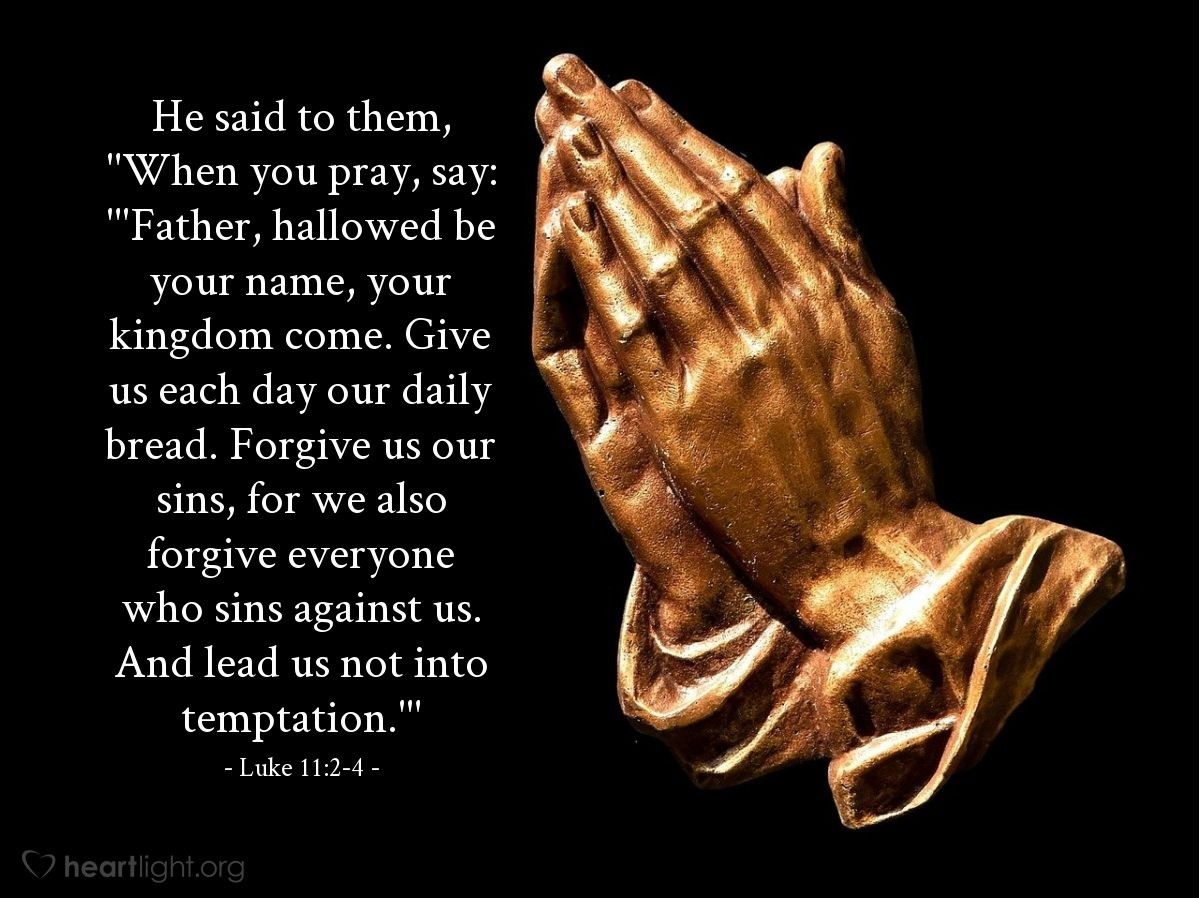
- In Jesus' model prayer in Luke 11:2-4, what two "concerns" related to God are listed first? Why? What personal "concerns" then follow? How do prayer and forgiveness relate?
- Why is persistence in prayer important? In what ways does the Lord's prayer serve as a model for us to follow? What are the dangers of reciting the same prayers over and over?
- In this prayer, Jesus is not giving us precise words to recite. Rather, he is giving prayer topics. What are these prayer topics?
- What does the parable in Luke 11:5-8 teach about prayer? How does Luke 11:9-10 related to the parable? What attitude is implied in these verses? How does Luke 11:11-13 clarify the intent of verses 9-10?
- What steps can we take to keep our prayers honest and meaningful?
- I will ... What has the Holy Spirit revealed to us in this passage? How can I apply it to my life this week?
- What should be the relationship between this prayer and our own? How do you usually pray? Do you have a set time? A set place? Or are you more spontaneous when you pray?
- Think of a time when you felt like giving up on a certain prayer request. What helped you keep on praying?
- What do you use to prepare for prayer: Read a psalm? A devotional guide? A hymn?
- What concerns occupy most of our time in prayer: Praise? Confession? Thanksgiving? Petition/supplication? Why? In which are do you want to grow?
- What is the most valuable gift God can give according to verse 13? How much do you want that gift? Why?
- What one thing would you like to obtain from the Father?
- You can ... Who do you know who needs to hear this? Feel free to share with others by social media links at the bottom of this.
Parables -
Parables about God & Prayer
Luke 11:5-13; 18:1-14
———————————————
Mobilizing People For Prayer — God is a loving Father who listens at a moments notice and always answers as quickly. The field of prayer is so vast that it would be difficult to catalog all the varieties of prayer, the rules of prayer and the methods of prayer known to Christian people. But prayer works; we must believe that. Richard Foster in his book Celebration of Discipline said, "We are working with God to determine the future. Certain things will happen in history if we pray rightly." Remember the scripture from James: Elijah prayed that it would not rain, and it didn't; then he prayed that it would rain, and it did. James' presumption is that history would have been different if Elijah had not prayed. So what does it take to help us as individuals have a superior lifestyle of prayer? Let me list four rules.
1. The first rule is praying with faith. "This is the confidence that we have in Him, that if we ask anything according to His will, He hears us" (1 John 5:14). The more certain we are that what we are praying for is God's will, the more faith we can have.
2. The second rule of prayer is praying with a pure heart. We must constantly be on guard that the motives behind our prayers are the right motives. "When you ask, you do not receive, because you ask with wrong motives, that you may spend what you get on your pleasures" (James 4:3).
3. The third rule of prayer is praying with power. All spiritual power we have comes through God's Word and the Holy Spirit. "If a son asks for bread from any father among you, will he give him a stone?" and then He immediately adds: "If you then, being evil, know how to give good gifts to your children, how much more will your heavenly Father give the Holy Spirit to those who ask Him!" (Matthew 7:9-11).
4. The fourth rule of prayer is praying with persistence. Praying about something just one time is not enough; we must pray for it again and again before we see the answer we are expecting. The persistent widow in Luke 18 is a great example of how each of us need to continue to pray persistently and fervently.
Opening Questions — Get Us Thinking:
What is the funniest prayer you've heard a child say?
What have you learned about prayer later in your life?
The Parable on Prayer— Luke 11:5-13
The Parable of the Persistent Widow
1Then Jesus told his disciples a parable to show them that they should always pray and not give up. 2He said: “In a certain town there was a judge who neither feared God nor cared what people thought. 3And there was a widow in that town who kept coming to him with the plea, ‘Grant me justice against my adversary.’
4“For some time he refused. But finally he said to himself, ‘Even though I don’t fear God or care what people think, 5yet because this widow keeps bothering me, I will see that she gets justice, so that she won’t eventually come and attack me!’ ”
6And the Lord said, “Listen to what the unjust judge says. 7And will not God bring about justice for his chosen ones, who cry out to him day and night? Will he keep putting them off? 8I tell you, he will see that they get justice, and quickly. However, when the Son of Man comes, will he find faith on the earth?”
The Parable of the Pharisee and the Tax Collector
9To some who were confident of their own righteousness and looked down on everyone else, Jesus told this parable: 10“Two men went up to the temple to pray, one a Pharisee and the other a tax collector. 11The Pharisee stood by himself and prayed: ‘God, I thank you that I am not like other people—robbers, evildoers, adulterers—or even like this tax collector. 12I fast twice a week and give a tenth of all I get.’
13“But the tax collector stood at a distance. He would not even look up to heaven, but beat his breast and said, ‘God, have mercy on me, a sinner.’
14“I tell you that this man, rather than the other, went home justified before God. For all those who exalt themselves will be humbled, and those who humble themselves will be exalted.”
· What is the main point of these parables?
Research Questions — “Dig Deeper” to find God’s Will
1. What do you expect from prayer? Make a list of your expectations.
2. When you pray to God, what does it look like to you?
3. When is repetitive prayer beneficial?
4. When is repetitive prayer harmful?
5. Prayer is a life-changing experience. How has it changed your life?
6. How would praying in the same closet with a tax collector make you feel? How about standing next to the Pharisee?
7. Is Jesus, through the parable of the unrighteous judge, saying that intercessory prayer is wrong? Is praying for each other merely ganging up on God to pester him into finally granting my request?
8. Two people ask you to do the same favor. Describe the person who asked you in an annoying way and thus causes you to refuse him.
9. Now describe the person who asked you for the favor in such a way that you will try your hardest to granted.
Reflective Questions — Live it today.
1. What changes do you think would occur if your family prayed together for an extended time every day?
2. What in our culture encourages people to believe that God is usually unwilling to help us and must be badgered by prayer to do so?
3. Besides nagging God with persistent prayer, what are other ways people today show that they feel God is not basically interested in helping us?
4. In what ways is the Holy Spirit the best gift God has ever given to you?
5. Because of Jesus message to me through these parables, the main way I will improve my prayer life is...
6. Write a prayer of praise to God.

Other Resources:
How To Talk To God (Luke 11:1-13)


No comments:
Post a Comment