Tuesday, July 02, 2024

#127 Jesus warns of coming judgment John 8:21-30 - Life of Christ = Week 26 - Tuesday

 Jesus warns of coming judgment

John 8:21-30

Intro Questions

Text Graphic
  • God is ... What do we learn about God in this passage?
  • We are ... What do we learn about people in this passage?

  • I will ... What has the Holy Spirit revealed to us in this passage? How can I apply it to my life this week?

  • You can ... Who do you know who needs to hear this? Feel free to share with others by social media links at the bottom of this.


OPEN


DIG
  • What is at stake in this whole discussion (v. 24)? Why does everything hinge on who Jesus really is (v. 25) and who sent him (vv. 16, 18, 26, 29)? 
  • What does Jesus mean by each phrase in verse 28? How will this show people he is the Christ? 
  • What is the significance of verse 30 in light of the total misunderstanding of the Pharisees? How do the Pharisees exemplify darkness in this scene?


REFLECT


Other Resources: 
Mercy and Compassion John 8 https://virtualbiblestudy.com/lessons/john/8/


Monday, July 01, 2024

#126 Jesus is the light of the world John 8:12-20 - Life of Christ = Week 26 - Monday

 Jesus is the light of the world

John 8:12-20

Intro Questions

Text Graphic
  • God is ... What do we learn about God in this passage?
  • We are ... What do we learn about people in this passage?

  • I will ... What has the Holy Spirit revealed to us in this passage? How can I apply it to my life this week?

  • You can ... Who do you know who needs to hear this? Feel free to share with others by social media links at the bottom of this.


OPEN
  • What is your most vivid memory as a child in a dark place (cave, tunnel, power black-out)? What feelings do you associate with darkness?

DIG
  • What is Jesus really claiming in verse 12? What is the promise? What does Jesus mean by "light" and "darkness"? 
  • With what does Jesus bolster his claim (see 5:31-40)? What does it matter that Jesus knows where he comes from (vv. 14,21-23; see 7:41-42)? 
  • What does the Pharisees' question in verse 19 reveal about their relationship with the Father? 
  • What is at stake in this whole discussion (v. 24)? Why does everything hinge on who Jesus really is (v. 25) and who sent him (vv. 16, 18, 26, 29)? 


REFLECT
  • How is following Jesus like following someone with a light through a dark place for you? 
  • How do people you know misunderstand Jesus? How do their lives exemplify darkness? How can you be a light-bearer to them?


Other Resources: 


“Judge Not”

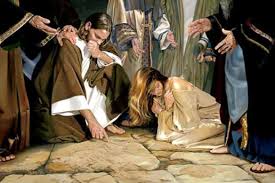
“But Jesus bent down and started to write on the ground with His finger. When they kept on questioning Him, He straightened up and said to them, ‘If any one of you is without sin, let him be the first to throw a stone at her.’” (referring to the woman caught in adultery) (John 8:6b-7)

Have you ever wondered what Jesus was writing on the ground? Was Jesus preaching to them, teaching them, challenging them, condemning them? Was he writing down a list of sins to which most of us fall prey, or was he just trying to distract attention away from the accused woman?

The majority of Christians understand that all sin is equal. Romans 6:23a tells how the consequences of all sin are the same: “For the wages of sin is death.” Though you may believe this, do you inadvertently equate sins differently? Such as: Homosexuality is worse than heterosexual promiscuity; Lying is worse than gossip; Stealing is worse than coveting, Murder is worse than anger. Remember the consequences for all sins are death. Thinking of sin in degrees of “bad” can quickly take you into dangerous territory.

Grading sins can take your eyes off Jesus. In Matthew 7:4-5, Jesus challenges those listening to Him, “How can you say to your brother, 'Let me take the speck out of your eye,' when all the time there is a plank in your own eye? You hypocrite, first take the plank out of your own eye, and then you will see clearly to remove the speck from your brother's eye.”

Judging others can cause you to take the place of God in your life (a very risky proposition). Even more, judging others reflects a misunderstanding of the atonement of Christ. You are a sinner not because of your degrees or amounts of sin, but simply because you are a sinner. Christ died for your sins, paying the price for your sins with the sacrifice of His life.

The crowd was ready to impute judgement on the adulteress when Jesus possibly began writing everyday sins of which we are all guilty: anger, hate, selfishness, disrespect, unforgiveness, pride, lust, etc. Who can say none of these sins are not your own? Once you focus on the sin instead of your Savior, it becomes about you. When you think someone else’s sin is worse than yours, you become prideful, if not delusional. As soon as you condemn another for his sin, you are ignoring your own sin.

How do you respond to another’s sin? With love! There is a story behind every sin:

•   A lost person who needs the love of Christ for salvation

•   One who cannot hold back sinful character traits because they hurt so badly on the inside

•   A babe in Christ who does not fully understand sin and desperately needs discipleship

•   A Christian who is calloused to his sin for lack of Christian fellowship where loving Christians can help him learn the Word as they model the Christian life.

•   A struggler caught in addiction.

None of these need judgment, but more of Jesus. The next time you are ready to judge, ask God to let you see with spiritual eyes. Inquire of God what He wants you to do in this situation. Ask Him to empower and equip you to love the one you are wanting to judge. You can never fully love God if you do not love people. Not loving God short changes your relationship with Him. On the other hand, you cannot love people if you do not love God. Loving God and loving people are mutually dependent actions that both illuminate who you are in Christ.

Colossians 1:13-14 “For He has rescued us from the dominion of darkness and brought us into the kingdom of the Son He loves, in whom we have redemption, the forgiveness of sins.”

Friday, June 28, 2024

#125 Jesus forgives an adulterous woman John 7:53-8:11 - Life of Christ = Week 25 - Friday

 Jesus forgives an adulterous woman

John 7:53-8:11

Intro Questions

Text Graphic
  • God is ... What do we learn about God in this passage?
  • We are ... What do we learn about people in this passage?

  • I will ... What has the Holy Spirit revealed to us in this passage? How can I apply it to my life this week?

  • You can ... Who do you know who needs to hear this? Feel free to share with others by social media links at the bottom of this.

OPEN
  • Describe a time in your childhood when someone tattled on you.

DIG
  • How is this situation a trap for Jesus? What would the Pharisees accuse Jesus of if he told them to let her go? If he told them to stone her? How does he spring the trap (v. 7)? 
  • How would the woman just caught in adultery have felt? What was the significance of Jesus' question in verse 10? 
  • How does Jesus' response to the woman exemplify "grace and truth" (1:17)?

REFLECT
  • How does the way Jesus treated this woman help you face your sins? 
  • Jesus accepts you "as is." Does that free you to change, or does it support your bad behavior? How so? 
  • What can you learn from Jesus about helping a friend who has fallen?


Some sinners the religious people wanted to write them off. Jesus wanted to write sinners into his story.

You see, religion places lost people on the outside and we build walls. Relationships place lost people on the inside. We are called to build bridges.

Self-righteous people are seldom aware of their judgmental spirit. I saw this some time ago.  I think it says it maybe better than I can say it.

A man fell into a pit and he couldn't get himself out:

  • A subjective person came along and said I feel for you down there
  • An objective person came along and said it's logical that someone would fall down there
  • A Christian scientist came along and said you only think you're in a pit
  • The pharisee came along and said only bad people fall into a pit
  • The news reporter came along and wanted an extensive story on the pit
  • A fundamentalist said you deserve your pit
  • A Calvinist said if you were saved, you had never fallen into the pit
  • A Wesleyan said you were saved and you still fell in the pit
  • A charismatic said just confess you're not in the pit
  • A realist came along and said oh – now that's a pit
  • A geologist came along and appreciated the rock strata of the pit
  • An IRS man came along and asked if he was paying taxes on the pit
  • A county inspector asked if he had a special permit to be in the pit
  • A self-pitying person said you haven't seen anything until you've seen my pit
  • The Las Vegas gamblers said chances are anyone could fall into the pit
  • The optimist said things could be worse
  • A pessimist said things will get worse
  • Jesus saw the man in the pit, reached down his hand, and took him out.

I would hope God is talking to your heart and two things are happening. First, I would hope that we who are Christ followers begin to see the big picture. That we value everyone as part of God's creation. He values everyone. Second, if you're not a person of faith and you don't have a relationship with God -- I hope that today as you're reading this, that you would feel valued. Because I want you to know, that God loves you so much that He gave his only son Jesus for you and me.


Other Resources:

Perseverance John 7 https://virtualbiblestudy.com/lessons/john/7/


Reflections on John - Drawing Circles (Part 1)

Jim McGuiggan examines John 8 and the events of the woman taken in adultery.  What can we learn from this?  How did Jesus handle the woman's situation?  Do we love others as Jesus loved this woman?  What should a person do when they sin again by doing the same evil deed? How does God feel about this?  Jim reflects on this passage and provides some insight for each of us.


Reflections on John - Drawing Circles (Part 2)
Reflections on John - Drawing Circles Part 2
John 8:1-11


Reflections on John (Part 3) - Drawing Circles 3
McGuiggan Reflections - Ep 12 
Reflections on John (Part 3)
John 8:1-11


Thursday, June 27, 2024

# 124 Religious leaders attempt to arrest Jesus John 7:32-52 - Life of Christ = Week 25 - Thursday

 Religious leaders attempt to arrest Jesus

John 7:32-52

Intro Questions

Text Graphic
  • God is ... What do we learn about God in this passage?
  • We are ... What do we learn about people in this passage?

  • I will ... What has the Holy Spirit revealed to us in this passage? How can I apply it to my life this week?

  • You can ... Who do you know who needs to hear this? Feel free to share with others by social media links at the bottom of this.


  I.      THE DISBELIEF JESUS ENCOUNTERS IN NAZARETH (7:1–10)

  II.      THE DIVISION JESUS ENCOUNTERS IN JERUSALEM (7:11–53): Jesus receives a mixed reception while attending the Festival of Shelters.

    A.      The reaction to the Savior (7:11–13, 20, 25–27, 30–32, 40–42)

      1.      From the people (7:11–13, 20, 25–27, 30–32, 40–53)

         a.      Some feel he is a good man (7:11–12).

         b.      Some feel he is a deceiver (7:12).

         c.      Some feel he is demon-possessed (7:20).

         d.      Some feel he is an ordinary man (7:25–27, 41b–42).

         e.      Some feel he is a prophet (7:40).

         f.      Some feel he is the Messiah (7:31, 41a).

      2.      From the Pharisees (7:30, 32, 44–53)

         a.      Their intentions to arrest him (7:30, 32, 44): It is not his time.

         b.      Their inability to arrest him (7:45–53)

           (1)      They are frustrated by the military (7:45–49): The guards sent out to seize him come back empty-handed, saying, “We have never heard anyone talk like this!”

           (2)      They are frustrated by a member (7:50–53): One of their own members, Nicodemus, now stands up for Jesus.

    B.      The response from the Savior (7:14–19, 21–24, 28–29, 33–39)

      1.      The overview (7:16–19, 21–24, 28–29, 33–34)

         a.      Jesus says that his mission and message originate from God (7:14–18, 28–29).

         b.      Jesus says that the people in his audience do not keep the law of Moses and in fact want to kill him right now (7:19).

         c.      Jesus asserts that both healing and circumcising are permitted by the law to be done on the Sabbath (7:21–24).

         d.      Jesus tells them that he will soon leave but that they will be unable to find him (7:33–36).

      2.      The offer (7:37–39)

         a.      What (7:38): Jesus offers streams of living water to all those who are thirsty!

         b.      When (7:37): Jesus makes the offer on the final day of the Festival of Shelters.

         c.      Who (7:39): Jesus speaks of the Holy Spirit, who will soon indwell all believers!


OPEN
  • When you played "hide and seek" as a kid (or with your kids), did you prefer hiding or seeking? Where was one of your best hiding spots? Did you stay hidden long, or jump out to scare the one seeking you?
  • When has someone jumped to a wrong conclusion about you? How did you feel?

DIG
  • Who is saying what about Jesus in this passage? What is causing the confusion? 
  • Why does Jesus' teaching in John 7:14-29 provoke the responses of John 7:30-31? How do you account for the wide range of opinions about him? For the timing involved? 
  • Every day at this feast, water would be poured out as a symbol of thanks for God's provision. In this context, what does Jesus' statement in John 7:37-38 mean? What are some ways that the Spirit's work is like water (compare John 4:13-14)? How is the Spirit received? 
  • How does the confusion over Jesus' birthplace (John 7:41-42) cloud the issue of his identity?
  • Why do the guards keep their hands off? What tensions do they feel? 
  • What justification do or the Pharisees offer in refuting the guards? Nicodemus (John 7:48,50)? Why would Nicodemus risk defending Jesus?

REFLECT
  • What evidence can you offer of the presence of the Holy Spirit in your life? How is his presence like flowing water? 
  • What is the relationship for you between believing the promises of Christ and experiencing the power of the Holy Spirit? 
  • What different opinions about Christ do you hear today? Why does that confusion exist?
  • When have you been ridiculed because of your faith? What did you do?


https://youtu.be/vgQfnshIAgg


Other Resources: 


Jesus Didn't Leave Us Behind


“On the last and greatest day of the festival, Jesus stood and said in a loud voice… ‘Whoever believes in Me, as the Scripture has said, streams of living water will flow from within him.’ By this, He meant the Spirit, whom those who believed in Him were later to receive. Up to that time, the Spirit had not been given, since Jesus had not yet been glorified.” (John 7:38-39)

The significance of the Holy Spirit in the life of a follower of Jesus Christ cannot be overstated. The arrival of the Holy Spirit on Pentecost, which occurred just ten days after Jesus ascended into heaven, marked a pivotal moment in Christian history. This event transformed the first disciples from a confused and frightened group of individuals, who were hiding in fear for their lives, into a bold, cohesive, and revolutionary band of leaders. These leaders went on to change the course of history, spreading the message of Jesus Christ far and wide. The key difference between the fearful disciples and the empowered apostles was the presence of the Holy Spirit.

Before His ascension, Jesus emphasized the importance of the Holy Spirit by instructing His disciples to wait for the power of the Holy Spirit before embarking on their mission. This directive highlights the necessity of divine empowerment for effective ministry. The disciples were not to rely on their own strength or understanding; instead, they were to wait for the promised gift that would enable them to fulfill their calling.

In the Old Testament, we see some instances where the Holy Spirit was made available to specific individuals at particular times. Figures such as Moses, Gideon, Joshua, Saul, David, Isaiah, and Zechariah were all empowered by the Spirit of the Lord. The Holy Spirit enabled these leaders to accomplish tasks that were beyond their natural abilities. However, the Spirit was not available to all God's people until after Jesus was glorified. Then the Holy Spirit was given to Christians.

With Jesus’ resurrection and the tearing of the temple curtain, a significant shift occurred in the relationship between God and humanity. Access to God’s presence was no longer limited to the priesthood or confined to the temple. Instead, God’s presence began to dwell within every follower of Christ. This monumental change signifies that the Kingdom of Heaven is not a distant reality but a present reality for believers.

The Holy Spirit serves multiple roles in the life of a believer. He is our comforter, guide, and advocate. The Spirit empowers us to live out our faith, equipping us with spiritual gifts and producing fruit in our lives that reflects the character of Christ. Galatians 5:22-23 outlines the fruit of the Spirit: love, joy, peace, forbearance, kindness, goodness, faithfulness, gentleness, and self-control. These qualities are not merely aspirational; they are the natural outflow of a life lived in communion with the Holy Spirit.

Moreover, the Holy Spirit plays a crucial role in our understanding of Scripture. As we read the Bible, the Spirit penetrates our minds and hearts, helping us to grasp the truths contained within its pages. This divine guidance is essential for spiritual growth and maturity. Without the Holy Spirit, our understanding of God’s Word would be limited, and our ability to apply its teachings to our lives would be hindered.

The presence of the Holy Spirit also fosters a sense of community among believers. In 1 Corinthians 12, Paul describes the Church as the body of Christ, with each member playing a vital role. The Holy Spirit unites us, empowering us to serve one another and fulfill our collective mission. This unity is not based on our individual strengths or backgrounds but on our shared experience of the Holy Spirit’s work in our lives.

In a world that often feels chaotic and uncertain, the promise of the Holy Spirit brings comfort and assurance. Jesus did not leave us to navigate life on our own; He provided us with the Holy Spirit to guide, empower, and sustain us. This divine presence is a reminder that we are never alone in our journey of faith. The Holy Spirit is with us, offering wisdom in times of confusion, strength in times of weakness, and peace in times of turmoil.

As we reflect on the significance of the Holy Spirit, we are reminded of the incredible gift that God has given us. He did not leave us as orphans; instead, He sent the Holy Spirit to dwell within us. This reality transforms our understanding of our relationship with God. We are not merely followers of a distant deity; we are children of God, filled with His Spirit and empowered to live out our faith in the world.

Thought of the Day: God has come to dwell within us; the Kingdom of Heaven is near. Thank you, Jesus, for not leaving us on our own. Your promise of the Holy Spirit is a testament to Your love and faithfulness. As we embrace this gift, may we be empowered to live boldly for You, sharing the good news of the Gospel and reflecting Your love to those around us.


Wednesday, June 26, 2024

#123 Jesus teaches openly at the Temple John 7:10-31 - Life of Christ = Week 25 - Wednesday

 Jesus teaches openly at the Temple

John 7:10-31

Intro Questions

Text Graphic
  • God is ... What do we learn about God in this passage?
  • We are ... What do we learn about people in this passage?

  • I will ... What has the Holy Spirit revealed to us in this passage? How can I apply it to my life this week?

  • You can ... Who do you know who needs to hear this? Feel free to share with others by social media links at the bottom of this.
OPEN:
  • From your school days, what rule seemed pointless or silly? Did you break it?

DIG:
  • Given the risk, why did Jesus go to the Feast of Tabernacles (John 7:16)? How did the people react to Jesus' teaching? Why? 
  • What do Jesus' responses reveal about his authority? 
  • How would you respond if you were in the crowd? 
  • What point are the leaders missing?

REFLECT:
  • How does Jesus reveal himself to you today? Are you ever upset by what he says? Why? 
  • When have you seen religious principles put ahead of love?


Other Resources: 


Monday, June 24, 2024

#121 Jesus' brothers ridicule him John 7:1-9 - Life of Christ = Week 25 - Monday

 Jesus' brothers ridicule him

John 7:1-9

Intro Questions

Text Graphic
  • God is ... What do we learn about God in this passage?
  • We are ... What do we learn about people in this passage?

  • I will ... What has the Holy Spirit revealed to us in this passage? How can I apply it to my life this week?

  • You can ... Who do you know who needs to hear this? Feel free to share with others by social media links at the bottom of this.

OPEN:
  • Were you ever dared by your brothers or sisters something dangerous? What happened?

DIG:
  • Why did the religious leaders want to kill Jesus (John 7:5:18)? 
  • In urging Jesus to attend this feast, are the brothers being wise or worldly (John 7:2-5; John 7:6:42, 66)? 
  • What rumors are circulating about Jesus in Jerusalem (John 7:12-13)? Hence, why do you think he chose to go secretly?

REFLECT:
  • Do you face any family opposition to, or ridicule of your faith? How do you deal with it? How does Jesus' situation help? 
  • Are you loved or hated by the world (John 7:7)? Why? 
  • Are you more likely to be cautious in sharing your faith with your family? Why?


October 23, 2022, Teaching at Festival of Tabernacles (7:1-24) by Paul Adams
https://youtu.be/GlDRDt1vtog

Monday, June 03, 2024

#101 Many Disciples Desert Jesus (John 6:60-71) - Life of Christ = Week 21 - Monday

Many Disciples Desert Jesus
John 6:60-71


OPEN:
  • How did you feel when a friend or sweetheart first rejected you?

DIG:
  • What teaching do Jesus' followers find so unacceptable (John 6:54-56)? 
  • Why do you think Peter and the others decided to stay? How does this relate to John 6:65?

REFLECT:
  • What words of Jesus are hard for you to accept? 
  • Have you known anyone who stopped following Jesus? How did their action affect you? 
  • How do people today make Jesus into an errand boy for their own personal agendas? How have you been tempted to do so?


Other Resources: 
Evangelizing Through Community Involvement John 6 https://virtualbiblestudy.com/lessons/john/6/


https://youtu.be/suGoxnPdAV8


You Are My All in All - A Capella

Friday, May 17, 2024

#100 The People Disagree That Jesus is From Heaven (John 6:41-59) - Life of Christ = Week 20 - Friday

The People Disagree That Jesus is From Heaven
John 6:41-59


OPEN:
  • What type of bread are you today: All natural? Rye? Moldy? Crusty? Fresh? Easy to butter up?

DIG:
  • In John 6:41-42, how do the crowds respond to his claims? How is the principle of the hometown prophet (John 4:44) played out here? 
  • What part is played by God and by the people in the process of coming to know Jesus (John 6:44-45)? What promise is repeated three times for those who do come to him? Why the emphasis on this? 
  • How is the "bread" he gives greater than that of Moses (John 6:32, 49)? 
  • Why does Jesus develop the food analogy even more graphically (John 6:53-58)? 
  • What does Jesus mean by "eating his flesh" and "drinking his blood" (John 6:51-58)?


REFLECT:
  • Has your familiarity with Jesus (from Sunday School stories, Christian school, etc.) ever kept you from seeing who he really is? What can remove the blinders? 
  • If someone asked, "How do you hunger and thirst after God," what counsel could you offer?


Other Resources: 
Evangelizing Through Community Involvement John 6 https://virtualbiblestudy.com/lessons/john/6/


Thursday, May 16, 2024

#099 Jesus Is The True Bread from Heaven (John 6:22-40) - Life of Christ = Week 20 - Thursday

Jesus is The True Bread from Heaven
John 6:22-40

Intro Questions

Text Graphic
  • God is ... What do we learn about God in this passage?
  • We are ... What do we learn about people in this passage?

  • I will ... What has the Holy Spirit revealed to us in this passage? How can I apply it to my life this week?

  • You can ... Who do you know who needs to hear this? Feel free to share with others by social media links at the bottom of this.


OPEN:
  • What type of bread are you today: All natural? Rye? Moldy? Crusty? Fresh? Easy to butter up?

DIG: 
  • Why are the crowds still searching for Jesus (John 6:24-26)? 
  • How does Jesus' response to their question show the difference between his interests and theirs? 
  • How are they to work for the food that leads to eternal life (John 6:29)? 
  • What does the crowd ask Jesus to do in order that they can believe him? What is their real interest? 
  • How does Jesus use their interest in food to illustrate what he wants them to under-stand? What are the similarities and differences between manna (Exodus 16) and the "bread of life" (John 6:35)? 
  • What claims does Jesus make in John 6:35-40? What do these claims emphasize about his being the bread of life? About the will of the Father? 


REFLECT:
  • What is the main reason you follow Jesus? 
  • How would you describe your daily spiritual diet: Junk food? Frozen food? Baby food? TV microwave food? Leftovers? Meat and potatoes? Pure bread and wine? 


Jesus’ Seven “I Am” Statements

#IAm:InHisOwnWords


"Making Time for Real Food"

“Do not work for food that spoils, but for food that endures to eternal life, which the Son of Man will give you.” (John 6:27)

We live in a busy and hectic world.  In the busyness of life, it is easy to relegate God to the back seat of our lives.  When people are asked to describe their daily walk with Christ, they often reply, “I pray during the day.”  Upon further inquiry, there is usually no reading of the Bible outside a verse or two, while most prayer is done on the run or only in times of crisis.

In Luke 10:27, Jesus describes what our relationship with God should look like, “Love the Lord your God with all your heart and with all your soul and with all your strength and with all your mind.”

Loving God this way is comprehensive.  An examination of most of our schedules would not offer much of an excuse for not setting aside one good time period each day to feed on the Giver of life.  Jesus said in John 6:32-33, “It is My Father who gives you the true Bread from heaven.  For the Bread of God is He who comes down from heaven and gives life to the world."

Most people eat two to three meals a day and snack between.  If we can make time for the food that spoils, can’t we surely make time for the food that gives abundant life?

Establishing the need for satisfying your hunger and thirst for Jesus is essential for living out and experiencing your life in Christ.  In John 6:28, Jesus was asked how to live the Christian life: “What must we do to do the works God requires?" They were expecting a laundry list of requirements.  Jesus surprised them in John 6:29 when He answered, “The work of God is this: to believe in the One He has sent."

Pretty simple.  Jesus said he was the Bread of Life.  We demonstrate our belief by feeding on Jesus, our food, for our existence.  Just as you go to the kitchen to get food, you should go to Jesus to be fed your eternal food.

The root problem of growing and experiencing Christ is our unbelief.  You believe your hunger can be satisfied in the kitchen of life: priorities, entertainment, fun, sports, movies, etc.  But do you really believe that Jesus can satisfy the longings of your life?

Jesus goes on to say in John 6:63, “The Spirit gives life; the flesh counts for nothing.  The words I have spoken to you are Spirit and they are life.”  Just as you feed on three meals a day plus snacks, you must also feed on Jesus through his Word, a devoted prayer life, and continual prayer throughout the day.  God will take hold of your life—if you allow Him.  God will satisfy your innermost needs—if you give yourself to Him.  God will surround you with His love, grace, peace, and satisfaction—if you make Him the provision of your life.

==========

"Feeding on Jesus"

“Jesus answered, ‘The work of God is this: to believe in the One He has sent.’” (John 6:29)

It would be easy to read this section of Scripture (John 6:29-58) rejoicing only in the salvation we have in Jesus. This teaching of Jesus goes beyond just declaring Jesus as the only Source of salvation; it shows how to live the Christian life through faith. Faith not only ushers you into the throne room of God for eternity, but your faith is also the sustaining work of God for His life in you. It is not you who accomplishes God’s work, but Jesus through the work of the Holy Spirit in you.

John 6:56-57 helps us to visualize how this happens as we find spiritual sustenance and nourishment with Jesus: “Whoever eats My flesh and drinks My blood remains in Me, and I in him. Just as the living Father sent Me and I live because of the Father, so the one who feeds on Me will live because of Me.”

By continuing to feed on Jesus you remain in Him. The natural result of remaining in Jesus is to grow into His likeness as you trust His leading (drink). Trusting Jesus releases the work of the Holy Spirit for His work in and through you. Jesus introduced this concept in John 4:34 when He said, “‘My food,’ said Jesus, ‘is to do the will of Him who sent Me and to finish His work.’”

As you feed on Jesus, His will and life will become a commanding presence and desire to not only follow Him, but to also obey Him. Following and obeying will always be fed by believing and not merely laboring to do so. It is the practice of continually reminding yourself of the gospel, believing it, and stepping out by trusting the work of the Holy Spirit in you.

The victorious Christian life rides on faith, while believing in the finished work of Jesus that is expressed in Philippians 1:6 that says, “Being confident of this, that He who began a good work in you will carry it on to completion until the day of Christ Jesus.”

When fear grips you or you are at a loss on how… or you are just exhausted from where you are currently, then come back to Jesus for faith, refreshment, and rejuvenation as in John 7:37-38, “If anyone is thirsty, let him come to Me and drink. Whoever believes in Me, as the Scripture has said, streams of living water will flow from within him.”

Never forget that the work of God begins by believing in Him and ends by believing in Him.

John 6:35 “Then Jesus declared, ‘I am the bread of life. He who comes to Me will never go hungry, and he who believes in Me will never be thirsty.’” (NIV)